
HIGH MOUNTAINS, DEEP OCEANS
BOOK ONE: THE SEA WITHIN
PREFACE
February 2024 — A Hospital Room, Phuket, Thailand
I used to trust instruments. A barometer falling like a bad feeling. A compass steady enough to bet your life on. A sky that told the truth if you knew how to read it.
Now, a machine keeps time for me.
It draws my life as a jagged green shoreline: spike, drop, spike, drop. It clicks and hisses, a tiny weather system trapped in a box. The room smells like antiseptic and warmed plastic—clean, but comfortless.
My hands tremble. Not from cold summits or long passages. Not from any storm I can name on a chart. From the plain, brutal fact of still being here.
Two days ago, my father died.
Two days ago, I learned what else he'd done. Quietly. Legally. With the soft violence of a pen. He erased something he could never restore.
Two days ago, as that final betrayal settled into my chest like wet cement, my heart failed. Not metaphorically. Literally.
They rushed me into the emergency room. Fluid pooled in my lungs. My body folded under a lifetime of gravity I'd spent years trying to outrun. Nurses called numbers into the air. A doctor pressed two fingers to my wrist and then looked up—focused, unsentimental, unkind only in the way urgency has no time for tenderness.
I have survived things that looked more dramatic from the outside—storms that tried to tear the rig apart, reef passes with no room to be wrong, stretches of forced starvation when my throat sealed shut and swallowing became a form of strangulation. But a hospital has its own ocean: bright, indifferent, procedural. You don't steer it. You submit to it.
Lying there, watching strangers work to keep the rhythm of my life from slipping away, I understood something that took me decades to admit:
To understand why a heart finally stops, you first have to understand what made it beat so hard for so long.
This book is that reckoning.
You may have come for a sailing story. You'll get one. But I didn't write this as a hero conquering the elements; I wrote it as a man repeatedly humbled by them.
You'll meet the boy who believed pain was proof, the teenager who thought endurance was a kind of currency, the young man who believed if he just kept moving—far enough, fast enough—he could outrun the shape of his own story. You'll see me sail without an engine, navigate by starlight and stubborn will, gamble on seamanship because seamanship felt like the one thing I could control.
When weather turned violent, I knew what to do. When my body turned against me, I didn't.
But don't be fooled by the horizon.
This story doesn't move in a straight line because survival doesn't. Memory is tidal. It withdraws. It returns. It brings up what you thought you buried.
As we sail forward, the undertow of the past will pull at us—sometimes gently, sometimes like a riptide. To understand the man I would later become, tested in ways I could not yet imagine, you will first have to meet the boy locked behind the sterile, screaming doors of Fairfax Mental Hospital by the very father who should have protected him.
And deeper still, you will stand with me on a deck in warm tropical light and feel the moment when the ocean—once refuge—reveals a different face.
We'll return to deserts that scorched me clean and mountains that taught me to suffer with style. We'll trace the miles where silence meant safety and suffering meant legitimacy. We'll sail until I forget what hunger used to feel like. We'll break. Then we'll rebuild.
I spent most of my life chasing distance, convinced that if I went far enough, I could outpace the boy I used to be.
I was wrong.
We carry our ghosts in the hold. We lash them down. We pretend they're cargo. But they come loose in heavy weather.
So come aboard.
The water is deep. The current is strong. There is real danger in these pages—on the sea, in the body, and in the choices a man makes when he believes he has no other way to survive.
But if you hold fast, we will make the harbor.
This book charts the descent and the first return—the years when survival looked like solitude, and when motion felt like meaning. The story does not end here. But this is where the reckoning begins.
— Todd Forney
Chapter 1 The Gray Wall
PART I
THE DESCENT
(The Starving Sailor)
Dead Reckoning (n.)
Moving with imperfect information and full responsibility. The method of kids who had to navigate without maps, just consequence.
"To young men contemplating a voyage I would say go."
— Joshua Slocum
STRAIT OF JUAN DE FUCA — 2001
Interlude I: The Honest Line
I'd built my life on the quiet math of what I could survive.
Not success. Not connection. Just endurance.
If I kept moving, I wouldn't be caught.
If I kept suffering, no one could say I hadn't earned whatever little peace came next.
This was the trade: pain for clarity. Starvation for stillness. And sometimes, if I got lucky, silence.
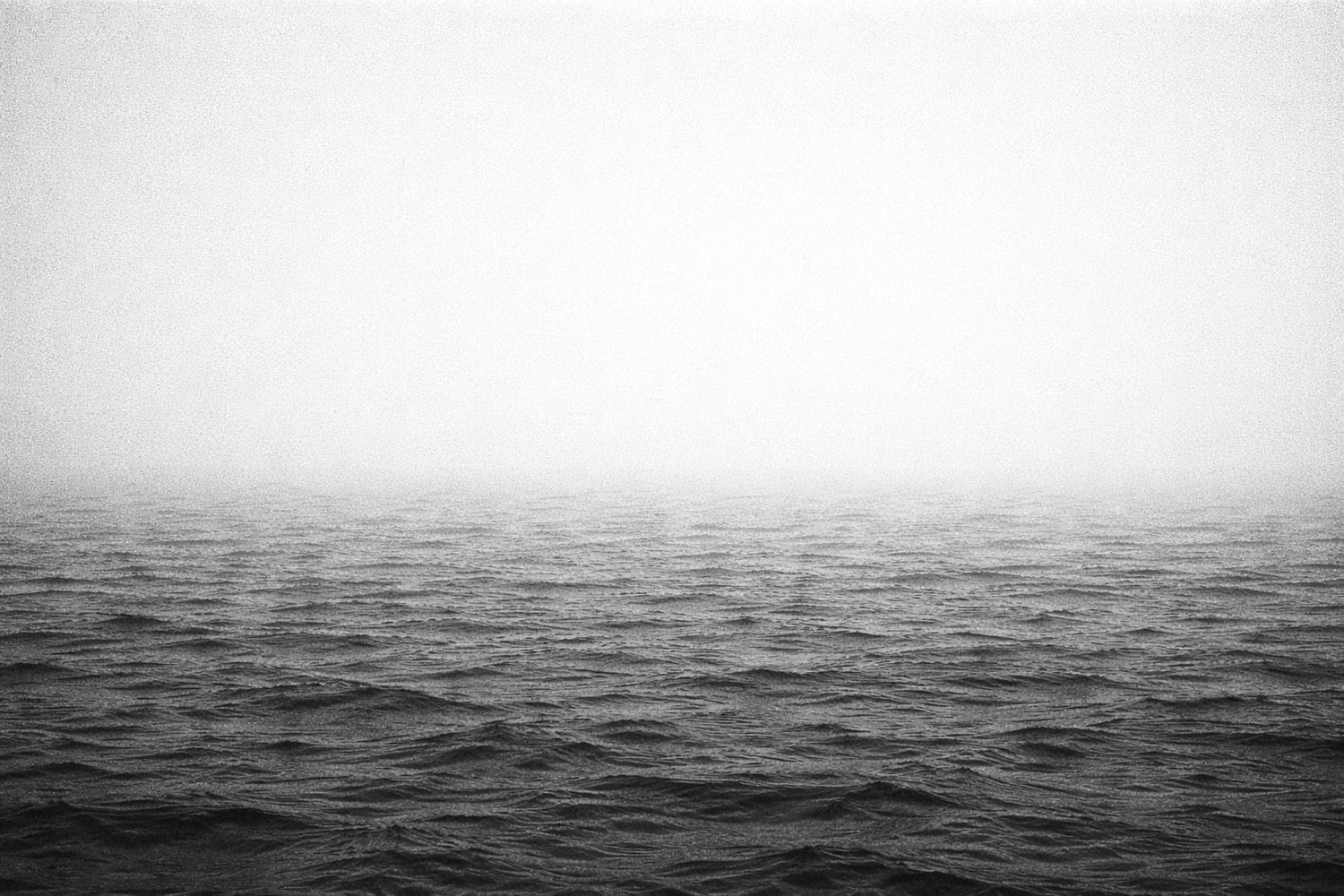
The fog erased distance so completely it felt designed. Sound arrived before shape. The water moved under me without horizon, without scale. I held course by numbers alone, trusting math over instinct. I had chosen this passage because it offered no margin—no engine, no shortcut, no way to pretend my body wasn't part of the equation. The harder line had always felt like the honest one.
And I craved the honest line, even when it cut.
When the world is removed, you are forced to inhabit yourself. Fog has a way of rewriting the world. Not with drama—with subtraction. Fog claimed the horizon first. Then it took the sun, until even the idea of distance meant nothing. The air felt dense—close enough to press against my eyes. Sound became my map: slap of water, rigging's creak, then the horn—low, somewhere ahead. Nothing else to judge it by. No edges. No scale. No reference points. Only presence and whatever was moving inside it.
A ship's horn cut through the gray—low, deliberate. Then it came again, not louder, just nearer to where my nerves were already tight. In fog, you don't get perspective. You get fragments.
I had no engine. No radar. No AIS to tell me what was coming. Just canvas and wind and a boat that could not stop quickly even if I begged it to.
Becalmed and engineless, I was a sitting duck in a gray void.
I held the tiller and listened. Salmonberry moved under me the way a living thing moves—small corrections, a slight lift of the bow, the constant insistence of water against a hull. I leaned forward as if that would help me see through the fog. It didn't.
The horn came back, and this time it felt placed. Close enough that my stomach tightened before my hands admitted it.
My pulse thudded in my ears, breath held without thinking, as if even breathing might summon what I couldn't see.
Two hundred miles still lay between me and open ocean. Between here and there were shipping lanes and shoals, strong tides, and the kind of wind that shifted without warning, as if it had preferences. It wasn't the miles that scared me. It was the margins.
I swallowed and tasted panic—the sour, metallic kind that comes from the body before the mind admits anything. I reached for the warm water bottle clipped by the companionway and took a drink. The water went down hard. It hesitated high in my chest—just long enough to make my jaw clench. I forced it down and told myself it was nerves. Fog does that. Dehydration does that.
The sound returned, closer now, threaded through the blank like a warning I couldn't place yet. The horn carried a faint vibration this time, a low shiver that seemed to pass through the hull before it reached my ears.
I told myself to do what sailors do: reduce it to steps. Hold course. Keep speed manageable. Don't panic. Don't invent stories.
But fear isn't a story in fog. Fear is math you don't have all the numbers for.
A container ship could be doing twenty knots. In low visibility, you could be dead before you ever saw it. You could do everything right and still be wrong.
For a heartbeat, I pictured steel erupting out of the gray, the bow appearing where there would be no time left to move.
For a moment I pictured turning back, letting the current carry me toward the nearest safe harbor. The thought arrived clean and reasonable—almost a kindness. Then it was gone, replaced by something harder. I had set this course. I had chosen an engineless boat because I wanted to know what it would cost. I kept my grip on the tiller and stared into nothing.
The fog thinned slightly, not enough to reveal anything, just enough to make the emptiness feel larger. Somewhere in front of me, a ship moved through that same blankness, unbothered. I listened for its horn and waited for the next data point. The waiting was its own strain—the kind that makes you imagine motion where there isn't any and danger where there might be none.
When the horn sounded again, it came from off my port bow. I adjusted course a few degrees and felt Salmonberry respond, small and obedient. That obedience was the trap. It made me believe I could steer my way out of everything.
I had always understood risk as something you could negotiate with willpower. Mountains made that belief easy. You climbed. You endured. You reached the summit or you didn't.
The ocean didn't offer the same bargain. The ocean didn't care how hard you wanted something. It didn't even care how prepared you were. It was vast and indifferent and full of moving things you couldn't see.
A final horn sounded—then faded—no longer a threat, just confirmation that it had passed.
My hands trembled as I loosened my grip on the tiller, a breath escaping me late, like it had been waiting for permission.
My shoulders dropped half an inch. Only then did I realize how rigid I'd been. The calm that followed didn't feel like safety.
I'd learned long ago what it meant to be unable to leave.
It shouldn't have mattered. It was just one ship. One morning. One set of decisions in a voyage that had already taught me plenty about squalls, sleepless nights, and the way ocean weather can change its mind without asking yours.
But there was another kind of danger waiting—not in the fog ahead, but somewhere farther along, where the water was calm and the light deceiving.
✦ ✦ ✦
Months later, in Anaho Bay, in the Marquesas, the water had been glass. I'd tried to anchor alone in the back of the bay where a single boat rested—quiet water, emerald cliffs, the kind of place that looks like rest from a distance. The scent of frangipani drifted offshore. The light was warm. It should have been simple.
I tacked in, dropped sail, and sprinted forward to set the anchor. As I reached the bow, a katabatic gust came off the cliffs—fast, cold, and unannounced. It caught the sail before I'd secured it. The canvas snapped full with a sound like a gunshot. A sheet snagged. Salmonberry lurched and heeled hard.
I was on the bow, watching the boat accelerate without me.
The anchored boat grew rapidly in front of me. The other skipper stood in his cockpit, frozen, mouth open. The distance collapsed into seconds. I remember the strange clarity of details: the sunlight on his forearms, the angle of his mast, the way my own hands felt suddenly useless.
Salmonberry shot past him so close I could have reached out and touched his rail. Air whooshed between us. Then the anchor chain tore free from my grasp and plunged into the water. The boat shuddered and stopped so abruptly my knees buckled.
Heat crawled up my neck. Mortification has a temperature. I braced myself for shouting, for fury, for the kind of public humiliation that feels deserved.
I realized I was waiting to be scolded—a reflex from another life.
Instead a voice called across the water, bright and almost cheerful. "Bonjour! Je m'appelle Hervé."
I looked up. He was smiling. In his hands he held a platter covered with tropical flowers and fruit—bright, ridiculous, generous.
I stared at him, stunned by the mismatch between what I expected and what I was being offered.
"You sail alone, yes?" he called.
"Yeah," I said. "No crew. No engine."
He nodded slowly, as if he were tasting the idea. "Ah. You are strong. Why you sail alone?"
I reached for the easiest answer. "It's hard to find anyone with this kind of time," I said. "And I just… prefer it this way."
He paddled over in his dinghy and explained, simply, that welcoming new arrivals was a custom here. A gesture. A habit of kindness.
I didn't know what to do with that. I knew how to handle wind and water. I didn't know how to handle grace.
✦ ✦ ✦
That evening, after the fruit was gone and the bay had settled into the quiet that follows a day of small humiliations, I cooked rice and opened a can of fish. The meal was plain and good. I ate fast, hungry and still keyed up.
Halfway through a swallow, the food stopped.
It lodged behind my sternum like a fist. I tried to swallow again—nothing moved. I tried to breathe and the air came thin, useless. My spoon clattered into the bowl. My heart began to hammer as if it was trying to pound the blockage loose.
I braced myself against the counter. My throat was locked around that mouthful of rice and fish. I couldn't bring it down. I couldn't bring it back up. Coughing made it worse. Panic surged hard enough that my vision narrowed.
There was no seamanship for this. No trick. No anchor move to save me. Just me in the cramped galley, my own body refusing a function it had performed without thought my entire life.
I staggered up the companionway and grabbed the hatch frame. Outside, palm trees cut black shapes against the fading sky. The water lay still. If I blacked out and went over the side, that would be it. No one would see. No one would throw a line.
I forced myself to stand still and sip air like it was a privilege, waiting for something to change because I had no other option. Slowly—agonizingly—the pressure shifted. A thin channel of air opened. I leaned over the rail and retched. The bite came free in a string of spit and half-chewed fish, splattering into the bay.
I stayed there, hands white on the lifeline, gasping. My chest ached as if I'd been held underwater.
Storms made sense. Reefs made sense. This didn't.
When I could breathe normally again, I wiped my mouth and told myself what I wanted to believe: I'd eaten too fast. I was tired. It was nothing. Just one strange incident. I rinsed the dishes by headlamp and refused to let my hands shake.
I nearly died just now
.
By the time I crawled into my bunk, I had filed it away with everything else I didn't want to look at yet.
✦ ✦ ✦
Sailing without an engine is not heroic. It's just unforgiving. Every mistake costs more because you can't erase it with horsepower. You learn to wait. You learn to anticipate. You learn that sometimes the best move is no move at all.
Over time I learned techniques that allowed me to anchor alone under sail—dropping from the stern, setting without backing down, positioning the boat in currents that wanted to take her somewhere else. Those maneuvers would later matter in reef passes and river mouths and places where the ocean didn't give second chances.
But the lesson that mattered first wasn't technical.
Hervé had smiled at me after I nearly hit his boat. He had offered fruit like it was normal. My throat had betrayed me in the quiet of a safe bay. And in the fog, with a ship hidden somewhere ahead, I'd realized something I didn't like about myself:
I noticed that I trusted the boat more easily than I trusted people.
I didn't question where that instinct came from.
I called it discipline. But it was avoidance wearing a virtue's coat.
I told myself distance was the solution. I didn't yet understand what it had already cost me.
This is an excerpt from The Sea Within,
Book One of the six-part memoir High Mountains, Deep Oceans.
HIGH MOUNTAINS, DEEP OCEANS
© 2025 Todd Forney. All rights reserved.
Website Builder
Read about the book